— Focusing on Murder on the Orient Express and And Then There Were None
“In an era where judgment has become effortless, can we choose not to judge?”
Murder on the Orient Express and And Then There Were None—two masterpieces that continue to haunt us with the same question: Who has the right to judge?
※ Note: This article contains major spoilers for 'Murder on the Orient Express' and 'And Then There Were None'.
1. The Era of the Many vs. The Era of the Individual
In Murder on the Orient Express, judgment was undeniably a collective act. Twelve conspirators, twelve hands, twelve stab wounds. Because no single person was the sole killer, responsibility was perfectly diffused. The many shielded one another, and justice, in its traditional sense, vanished under the name of "consensus."
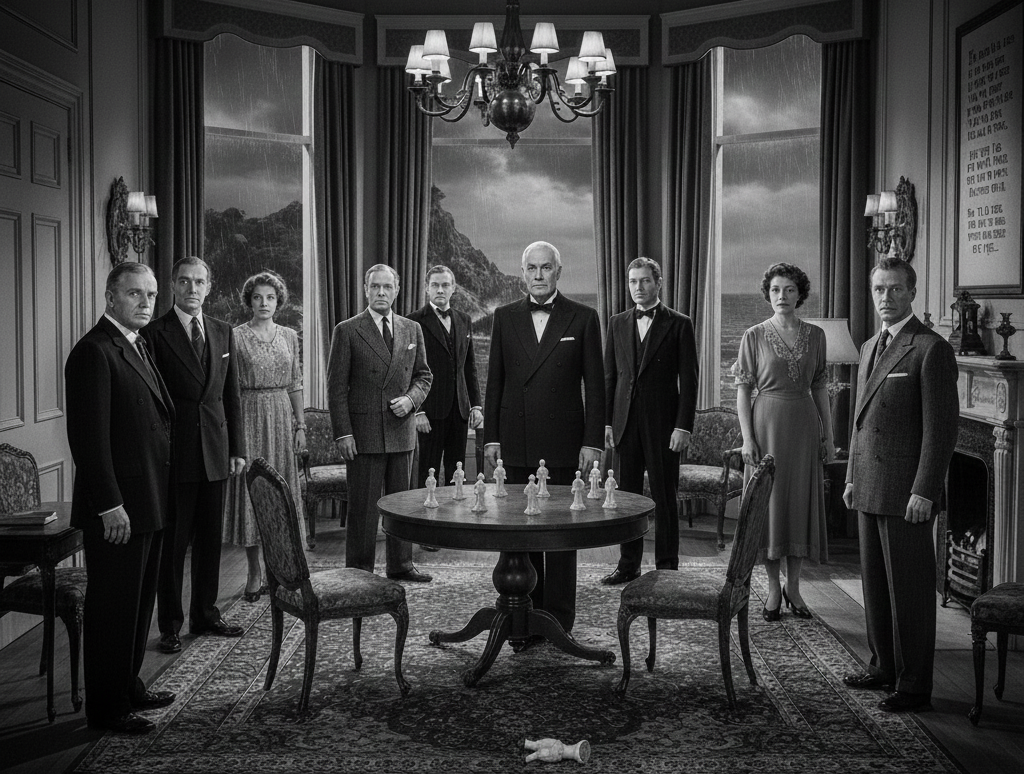
Today’s judgments, however, do not always require a crowd to start. It begins with a single word or a post from an influential individual. The crowd then forms rapidly in their wake. This structure brings to mind And Then There Were None, where one man’s unwavering conviction drives every judgment, justifying and reinforcing itself as it proceeds.
2. The Seat of Conviction
Judge Wargrave judged criminals by the standards of the law, yet he harbored his own painful past. This leaves open the possibility that his judgment was as much an act of self-pity as it was of justice.
Modern individual judgments stand in a similar position. The name of "Justice" strengthens one's conviction, but it is rarely clear whether that conviction has been sufficiently scrutinized. If a figure like Judge Wargrave existed today, how would he be evaluated? Might his actions be viewed through an entirely different lens depending on how a single person of global influence chose to portray him?
3. Where Do We Stand?
Someone accuses, someone joins in, and someone remains silent. These three roles appear distinct, but together they complete a single collective. Agatha Christie’s timeless question can be reframed for our modern age:
In an era where judgment has become so effortless, how far can we truly judge? And more importantly, how much courage can we find to withhold that judgment?
The silence of the many became the conspiracy in The Orient Express, while the conviction of an individual led to the tragedy of And Then There Were None. Today, we live in a world where these two structures are cunningly intertwined.
What kind of courage do we need now?
It is the courage to resist the temptation of certainty when fed only fragmented information.
It is the courage to endure the agony of observing complex nuances, rather than settling for the ease of black-and-white logic.
And finally, it is the courage to sheath the hasty bladepointed at others, and to practice love for humanity through the humility found in deep self-reflection.
Which scene of the novel are we standing in right now?
And more importantly—how should we stand?
Previously in this series:
[The Omnibus Edition] Agatha Christie: The Architect of Judgment and the Portrait of Modernity
The reason her works remain timeless is that she placed 'Human Vulnerability (The Why)'at the center of her design, rather than mere 'Method (The How).‘
[Series Part 1] Agatha Christie’s Masterpieces: Judges Above the Law
“If the law remains silent, how far can a human go as a judge?”
[Series Part 2] When Imagination Becomes Reality
“The Orient Express is no longer just a train on the snowy tracks; it has become a way of navigating the online world.”
References
‧A Self-Appointed Judge:
One who arrogantly places themselves above the law to render judgment.
‧The Hubris of Reason:
The belief that human judgment and logic are absolute and infallible.
‧Moral High Ground:
The perceived position of superiority that grants one the 'right' to judge others.
‧The Thinking Process
Phase 1 — The Question
Inspired by Murder on the Orient Expressand And Then There Were None:To what extent can a human become a judge when the law remains silent?How does this relate to Kant’s Categorical Imperative?
Phase 2 — The Distinction
What if judgment in these works is carried out by individual conviction versus collective consensus?How does the nature of responsibilityshift between these two structures?
Phase 3 — The Connection to Reality
If the imaginations of the past now mirror our current reality, which scene of the novel are we standing in today?